|
Main Pages Design Process
Latin Mottoes
Symbols (front)
Symbols (back)
Great Seals
|
How the Pyramid Side of the Great Seal
|
|
Wallace Recollects that Day
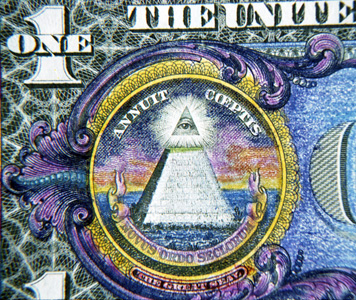
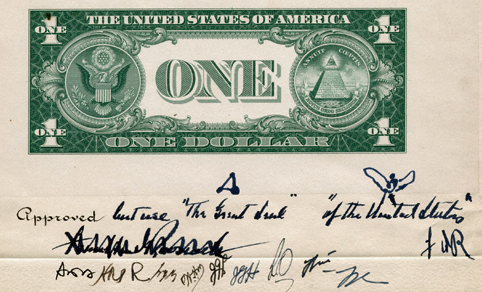
Turning to page 53, I noted the colored reproduction of the reverse side of the Seal. The Latin phrase Novus Ordo Seclorum impressed me as meaning the New Deal of the Ages. I was struck by the fact that the reverse side of the Seal had never been used. Therefore I took the publication to President Roosevelt and suggested a coin be put out with the obverse and reverse sides of the Seal. Roosevelt, as he looked at the colored reproduction of the Seal, was first struck with the representation of the "All Seeing Eye," a Masonic representation of The Great Architect of the Universe. Next he was impressed with the idea that the foundation for the new order of the ages had been laid in 1776, but that it would be completed only under the eye of the Great Architect. Roosevelt like myself was a 32nd degree Mason. He suggested that the Seal be put on the dollar bill rather than a coin and took the matter up with the Secretary of the Treasury. He brought it up in a Cabinet meeting and asked James Farley [Postmaster General and a Roman Catholic] if he thought the Catholics would have any objection to the "All Seeing Eye" which he as a Mason looked on as a Masonic symbol of Deity. Farley said "no, there would be no objection."
When the first draft came back from the Treasury, the obverse eagle side was on the left of the bill as is heraldic practice. Roosevelt insisted that the order be reversed so that the phrase "of the United States" would be under the obverse side of the Seal. |
The new $1 silver certificates began to be printed in the summer of 1935.
Unfortunately, Wallace is often reduced to a one-dimensional character by conspiracy theorists and writers who try to turn the Great Seal into an esoteric symbol. Learn the true story of this multifaceted man in American Dreamer: A Life of Henry A. Wallace, the excellent 2000 biography by John C. Culver and John Hyde.
"Wallace is among the most genuinely learned men in American public life
since Benjamin Franklin and Thomas Jefferson." – Paul Sifton, historian
"He epitomizes American civilization in its most genuine native form, the form which gave us an Andrew Jackson and an Abraham Lincoln. He is as earthy as the black loam of the corn belt, as gaunt and grim as a pioneer. With all of that, he has an insatiable curiosity and one of the keenest minds in Washington, well-disciplined and subtle, with interests and accomplishment which range from agrarian genetics to astronomy." – John Franklin Carter, The New Dealers (1934)
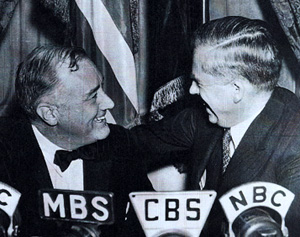
President Roosevelt understood Wallace.
On July 10, 1940, five days before the Democratic Convention, German warplanes made their first direct attack on England. With war on the horizon, FDR said, "Henry Wallace is the best man to nominate in this emergency." When one of FDR's close advisors worried that many people considered Wallace a mystic, Roosevelt snapped, "He's not a mystic. He's a philosopher. He's got ideas. He thinks right. He'll help the people think." That November Wallace was elected Vice President of the United States during Roosevelt's third term.
Henry A. Wallace – An Authentic American Dreamer