Shield on the Great Seal of the United States
|
1st committee
|
2nd committee
|
3rd committee
|
Charles Thomson
|
Original drawings of all four preliminary designs
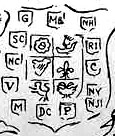
The first committee's shield designed by Pierre Du Simitière is bordered with the initials for "each of the thirteen independent States of America." Inside are symbols of the six "Countries from which these States have been peopled": rose for England, thistle for Scotland, harp for Ireland, fleur-de-lis for France, lion for Holland, imperial eagle (two-headed) for Germany.
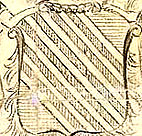
The first striped shield (red and white diagonal) was suggested by the second committee – the idea of Francis Hopkinson, who had designed the American flag in 1777.
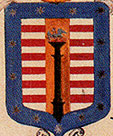
The consultant on the third committee, William Barton, wanted a shield of 13 horizontal stripes with a pillar in the center. That bird at the top is a "phoenix in flames."
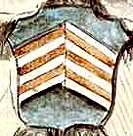
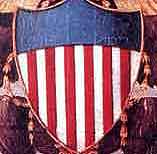 When Charles Thomson came up with the final design of the Great Seal, he first suggested a shield with 13 chevrons (top right), introducing the theme of mutual support that led William Barton to suggest the 13 vertical stripes (states) supporting a chief (federal government) we see today. The shape of the shield is not specified.
As stated in the official description of the Great Seal, the shield has
"thirteen pieces Argent and Gules: A Chief Azure."

This means the shield has seven white (argent) stripes, six red (gules) stripes, and a blue (azure) top section (Chief). Note: the American flag has seven red and six white stripes.
In heraldry, the shield and motto complement each other. Charles Thomson thought the first committee's motto "E pluribus unum" (Out of many, one) best captured the shield's symbolism, so he put it on the scroll held in the beak of the American bald eagle.
Symbolism of the Shield (paraphrase of official explanation)
The shield is composed of the blue Chief (top horizontal bar) and the red and white Pales (thirteen vertical stripes) which represent the several states all joined in one solid compact entire, supporting a Chief which unites the whole and represents Congress. The motto alludes to this union.
The stripes are kept closely united by the Chief, and the Chief depends upon the union and the strength resulting from it for its support to denote the Confederacy of the United States of America and the preservation of their union through Congress.
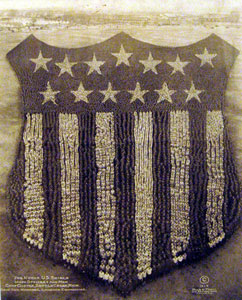
"The Human U.S. Shield:
30,000 Officers and Men" ©1918 Mole & Thomas
Shields are At the Heart of Heraldry
The shield is a warrior's primary piece of defensive equipment. They were first made of leather skins. Later, of tough wood covered with leather or metal, or entirely of metal – even including gold and silver.
Shields were decorated by staining the leather or beating the metal into shapes. They were also inlaid, and studded with nails or precious metal. The insignia of a warrior or knight was painted on his shield, making him easier to identify in a battle or contest.
By the thirteenth century, in England the various decorative "devices" on shields – and on the other aspects of a knight's armament – became systematized into the rules of heraldry that formalize the appearance of a coat of arms or seal.
|
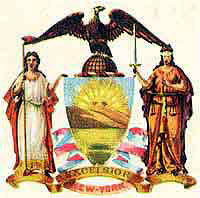 Supporters of the Shield
In heraldry, shields traditionally are held by two figures, one on either side. Called "supporters," they originated from the custom at medieval tournaments, when knights' shields were carried by attendants costumed as lions, bears, griffins, or other animals.
Supporters on Preliminary Designs:
- First Committee (1776):
- Goddess of Liberty and Goddess of Justice
(Same duo are on New York's state seal shown above.)
- Second Committee (1780):
- A Warrior and a Figure representing Peace
- Third Committee (May 1782):
- The Genius of America (represented by a Maiden) and an American Warrior
What's unique about the Great Seal of the United States is the absence of two figures supporting the shield. Charles Thomson explained: "The Escutcheon [shield] is born on the breast of an American Eagle without any other supporters, to denote that the United States of America ought to rely on their own Virtue."

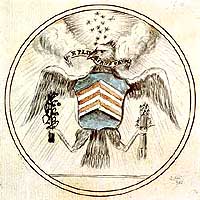
Charles Thomson's preliminary sketch
|
