|
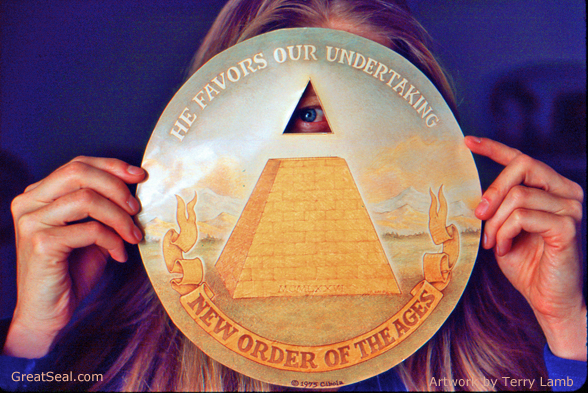
Myth and Misinformation About the Pyramid Side
of the Great Seal (on the Dollar Bill)
The Pyramid & Eye on the reverse side of the Great Seal is a misunderstood symbol that's becoming a casualty of lore: trivialized by the media as a background image on the evening financial news; commandeered by conspiracy theorists; abused by fiction writers.
The reverse side of the Great Seal was not designed with a hidden anagram that's found by drawing a six-pointed star whose points touch letters in the mottoes to spell MASON.
First of all, the original Great Seal is a written description only. No artwork was submitted to nor approved by Congress in 1782.
Also, drawing a star doesn't spell MASON on the reverse side's first realization (1786) or on the U.S. government's Centennial Medal (1882).
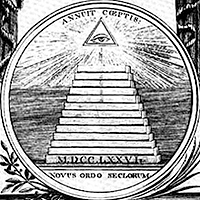
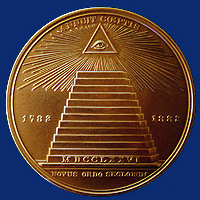
1786 1882
An anagram happens to work on the version first seen on the 1935 one-dollar bill, but this realization is not the work of America's founders and therefore not "proof that the Masons held secret influence over our early nation," as novelist Dan Brown claims.
The Great Seal's pyramid is not "truncated." It is "unfinished." (Big difference.) Another tip-off that a writer is missing the point of the Great Seal is when its symbolism is framed as "magical, arcane, occult, etc." Sure, there's mystery to history. But that's because the facts are unknown, not because they're unknowable or supernatural.
Beware of vague phrases such as: "It has been suggested..." or "There are some who claim..." or "Conspiracy theorists believe..." These are red flags signaling myth and speculation. A classic example is The History Channel's hour-long commercial program "Secrets of the Dollar Bill," where these phrases are used more than 20 times.
The origin of the Great Seal of the United States is neither "hidden" nor "little-known." Its history is very well documented. Less is known about the origin of the American flag.
There is no intended significance to the number of stones in the pyramid (nor the shadow it casts). Those details are determined by artists. Although the pyramid has been traditionally shown with 13 steps, no number is specified in the official 1782 description of the Great Seal.
- The Great Seal's official description does not specify a left or right eye.
- Its designers did not call it an "all-seeing eye" or the "eye of Horus."
- They referred to it as the "Eye of Providence."
Novus ordo seclorum does not mean "new world order."
- Novus ordo seclorum is an 18th-century Latin phrase (derived from a 1st-century B.C. one).
- "New world order" is a 20th-century English phrase that, if converted to Latin, would not be novus ordo seclorum.
- Ordo refers here to a sequence – not a system, hierarchy, or organization
- Charles Thomson explained that the motto refers to the new American Era commencing in 1776.
Thomas Jefferson said, "Eternal vigilance is the price of liberty." Today we should appreciate people who alert us to emerging threats to our freedoms from international (as well as national and local) organizations that manifest the negative consequences of what's termed "the new world order." But they should chose a new symbol, and stop demonizing the pyramid & eye.
The Great Seal was created by the people who gave us our freedom.
It does not represent those currently trying to take it away.
The Great Seal does not belong to any special group – past or present, covert or overt. It is an original American symbol created in 1782.
Of course, the perception of a symbol's meaning can change. Look what happened to the swastika – an ancient symbol of well-being – after the Nazis used it. That's why it's crucial for Americans to honor and protect their seal (as they do their flag) and not let it be commandeered by those who distort its meaning by using it as a logo to promote their paranoia.
Only four men actually contributed symbolic elements to the final
Great Seal design. These men were not Freemasons.
The Pyramid & Eye in National Treasure
|
