|
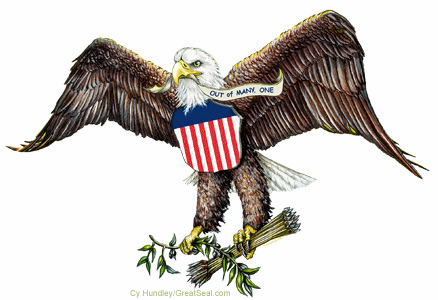
American Bald Eagle
on the Great Seal of the United States
When Charles Thomson put together the final design for the Great Seal in June 1782, he made its centerpiece an "American Eagle on the wing and rising." His preliminary sketch (below) is very important, because it's our only direct graphic link to the imagery he envisioned. That's because the Great Seal adopted by Congress is a written description only. No artwork was submitted nor approved.
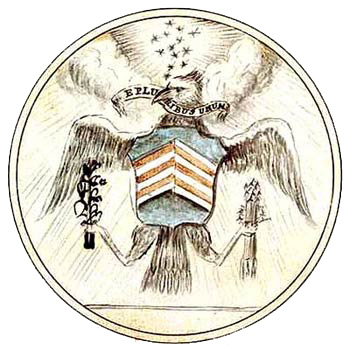 In the eagle's right talon, Thomson placed the olive branch suggested by the second committee whose designs had female figures representing Peace and Liberty holding the olive branch. The Eagle faces toward this ancient symbol that Thomson called "the power of peace."
In its left talon, the eagle holds the power of war symbolized by the bundle of 13 arrows.
On a scroll in the eagle's beak, Thomson put the motto E Pluribus Unum suggested by the first committee.
Above the eagle, rays of light are "breaking through a cloud" that surrounds a constellation of 13 stars.
For the final Great Seal, the stance of "the American bald Eagle" was changed from "on the wing and rising" to the more traditional "displayed" position (with its wing tips up):

(Escutcheon is the shield, and proper means in its natural color.)
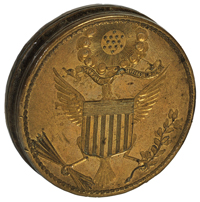
Also, the shield's stripes were changed to vertical ones. Here is the first die of the Great Seal (September 1782). Note that the image is reversed, so it will be correct when impressed on a document.
Although not specifically mentioned, clearly the American Eagle on the Great Seal represents liberty and freedom, a theme central to all three preliminary designs. Thomson underscored how the imagery symbolizes "Independence" by explaining that the shield is "born on the breast of an American Eagle without any other supporters, to denote that the United States of America ought to rely on their own Virtue."
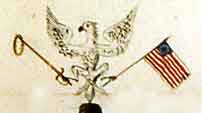 The third committee had a small white eagle at the top of their design (right). The first committee included a two-headed imperial eagle as a minor element on its shield. Both these eagles were old-world versions.
The eagle on the Great Seal has always faced the olive branch,
but not the eagle on the Seal of the President.
Ben Franklin muses about the wild turkey
as a symbol of "the temper and conduct of America."
The eagle has landed – on the moon
Top illustration: detail of Cy Hundley's realization of Charles Thomson's design
(with E Pluribus Unum translated): commissioned by GreatSeal.com in 2004.
The Eagle Speaks
|
