Great Seal > Mottoes > Annuit Coeptis

"This is the source of our confidence, the knowledge that God calls on us
to shape an uncertain destiny." – President Barack Obama, Inaugural Address

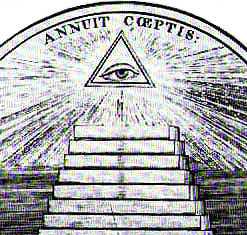
Detail of first engraving of the reverse side (Trenchard, 1786)

ANNUIT COEPTIS – Origin and Meaning
of the Motto Above the Eye

Secretary of Congress Charles Thomson suggested "Annuit Coeptis" when he put together the final design of the Great Seal in June 1782.

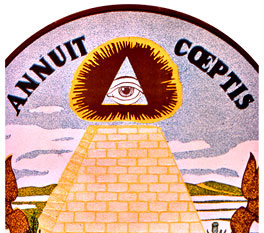
He placed the motto at the top of the Seal's reverse side, where its meaning is associated with the Eye of Providence in a triangle surrounded by light rays.

Thomson did not provide an exact translation of the motto, but he explained its symbolism: The Eye and the motto Annuit Coeptis "allude to the many signal interpositions of providence in favour of the American cause."

"Signal" means unusual, notable, outstanding.
"Interposition" means intervention. (In this case, a divine intervention.)

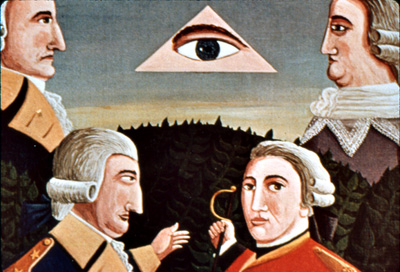
The Ancient of Days, William Blake (1794). Many leaders of the American Revolution felt that Providence had a hand in securing their Independence, particularly George Washington who often referred to the "smiles of Providence."

"I salute you Gentlemen most Affectionately, and beg leave to remind you, that Liberty, Honor, and Safety are all at stake, and I trust Providence will smile upon our Efforts, and establish us once more, the Inhabitants of a free and happy Country." (August 8, 1776)

"The many remarkable interpositions of the divine government. in the hours of our deepest distress and darkness, have been too luminous to suffer me to doubt the happy issue of the present contest." (March 26, 1781)

"The Commander in Chief earnestly recommends that the troops not on duty should universally attend with that seriousness of Deportment and gratitude of Heart which the recognition of such reiterated and astonishing interpositions of Providence demand of us." (October 20, 1781)

Translating ANNUIT COEPTIS

Annuit means to nod assent, to favor, to smile upon.
Coeptis means undertakings, endeavors, beginnings.

Annuit coeptis means "favors (lit., gives the nod to) undertakings." The subject must be supplied. Who favors? The Eye (Providence) does.

The verb annuit can be either present tense or perfect tense, therefore an accurate translation of the motto is: "Providence favors our undertakings" or "Providence has favored our undertakings." (The word "our" is supplied.)

(It has also been translated as: "He favors our undertakings" or "He has prospered our endeavors.")

The meaning of this motto is better understood when seen in its original classical context.

Discover the source of Annuit Coeptis.

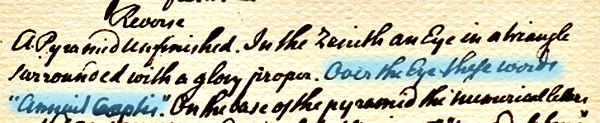
On June 20, 1782, Congress approved Thomson's design for both sides of the Great Seal, whose official description states:

"A Pyramid unfinished. In the Zenith
an Eye in a triangle surrounded with a glory proper.
Over the Eye these words 'Annuit Cœptis'
."

NOTE: "Coeptis" is interchangeable with "cœptis." That "œ" is an example of a ligature where two letters are combined into a single character.

"Annuit" does not mean "to announce" (which is annuntio).

Annuit Coeptis reflects the mottoes suggested for the third committee's reverse side
and Ben Franklin's suggestion for the first committee's reverse.

Find out how the pyramid & eye got on the one-dollar bill.

Explore GreatSeal.com.
Feel the inspiration America's founders experienced.

Main sections of the site's 76 pages

Learn the origin and meaning of the other MOTTOES:
E Pluribus Unum | Novus Ordo Seclorum

Examine the SYMBOLS on the Seal's Two Sides:
Dynamic imagery from nature and history.
Includes clickable image map.

See Preliminary DESIGNS for the Great Seal:
Ideas suggested by three committees (1776-1782).

Recognize MYTH and Misinformation:
Don't let America's emblem become a casualty of lore.

Get an overview on the Front Page.

GreatSeal.com is created and ©2009 by John D. MacArthur.