|
Main Pages
Front Page
Overview
Seal FAQs
Design Process
1st Committee
2nd Committee
3rd Committee
Final Design
Description
Explanation
Latin Mottoes
E Pluribus Unum
Annuit Coeptis
Novus Ordo Seclorum
Symbols (front)
Bald Eagle
Shield
Olive Branch
Arrows
Stars
Rays of Light
Cloud
Symbols (back)
Pyramid
Eye
MDCCLXXVI
Great Seals
Official Dies
First Engravings
First Painting
1792 Medal
Indian Medals
1882 Medal
One-Dollar Bill
Myths
Eagle Side
Pyramid Side
Themes
Unity
Peace
Liberty
Thirteen
Related
Wild Turkey
President's Seal
Sightings
Resources
|
The Great Seal of the United States
An Overview by John D. MacArthur
On July 4, 1776, the same day America's thirteen separate states united to declare themselves an independent nation, the Continental Congress took the next step necessary to demonstrate this Independence. They began to create their national emblem, the Great Seal of the United States.
During the next six years of the Revolution, three different committees submitted ideas for this graphic image of America, but none were acceptable. On June 13, 1782, Congress turned the task over to their trusted Secretary, Charles Thomson.
Using symbolic elements from all three committees, plus imagery and mottoes of his own, Thomson created a bold and elegant design. A week later, he presented the written description of this two-sided design to Congress, and Congress approved it that same day. The Great Seal of the United States was officially adopted on June 20, 1782. Ever since, its design has remained unchanged.
These are the only preliminary drawings
of the final design for the Great Seal:
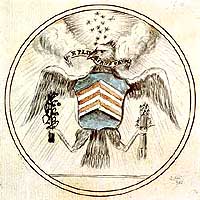
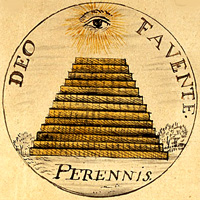
Sketches by Charles Thomson (June 1782) and William Barton (May 1782)
After these were drawn, a few revisions were made:
• The Eagle's shield was given vertical red & white stripes.
• New Latin mottoes were chosen for the pyramid side.
• A triangle was placed around the eye of providence.
• MDCCLXXVI (1776) was placed beneath the pyramid.
But no new drawings were made.
No artwork was submitted to nor approved by Congress.
The official Great Seal adopted on June 20, 1782
is in the form of a written description only.
The first die of the Great Seal was created in September 1782.
It had errors, as did subsequent dies. The U.S. government's most
accurate version of the Great Seal is the Centennial Medal of 1882:
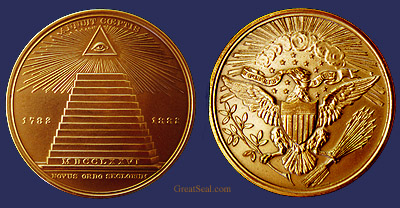
Some of the best examples of the eagle side are on the Indian Peace Medals given by President Washington in the 1790s. The Diplomatic Medal of 1792 is also outstanding.
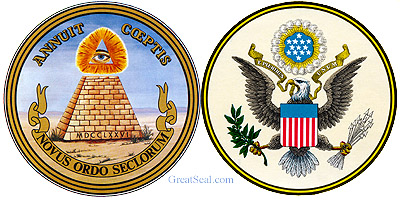
Illustrations of a seal are called "realizations."
Here are the U.S. Department of State's current realizations:
What's So Great About the Great Seal?
A cornerstone in the foundation of the United States, our Great Seal is a national treasure in the same league with our Declaration of Independence, Constitution, and Bill of Rights.
Designed by some of America's most visionary Founders during the revolutionary birth of our nation, the Great Seal is the carefully crafted message they created to convey their vision to the world, and to the future.
As our nation's vision statement, its two sides embody the essential guiding principles these farsighted patriots knew the United States must always follow.
So important was the Great Seal that on Day One – July 4, 1776 – Congress appointed Benjamin Franklin, John Adams, and Thomas Jefferson to begin the design process that would later involve two other committees.
Considerable attention went into creating the Great Seal. Unfortunately, most historians and educators have overlooked this extraordinary symbol. Consequently, myth and misinformation are commonplace, and the eloquent symbolism of the Great Seal is not fully appreciated.
It is time to rediscover our nation's forgotten treasure, the Great Seal of the United States, by telling Americans the fascinating story of this emblem that represents them.
As a graphic link to the vision of our nation's Founders, the Great Seal reconnects us with the revolutionary spirit of the people who gave us our freedom. Their struggle for independence is reflected in the Seal's preliminary designs that evolved into the two-sided symbol approved by Congress on June 20, 1782.
This is not just about the past, however. By knowing what the Great Seal's symbols and mottoes meant to the Founders, students will be able to decipher this remarkable message from their ancestors and discover its relevance today.
When the full story of the Great Seal is known, it becomes a compelling incentive to participate in America's future.
|
|
