|
Main Pages Design Process
Latin Mottoes
Symbols (front)
Symbols (back)
Great Seals
|
Third Great Seal Committee – May 1782A third committee was formed on May 4, 1782, as peace talks were underway in Paris between the United States and Britain. America would soon need a Great Seal to properly ratify a peace treaty. The committee consisted of chairman Arthur Middleton and John Rutledge (both of South Carolina) plus Elias Boudinot (New Jersey). Virginia's Arthur Lee seems to have replaced Rutledge early on. As with previous committees, they sought a consultant. They chose William Barton.
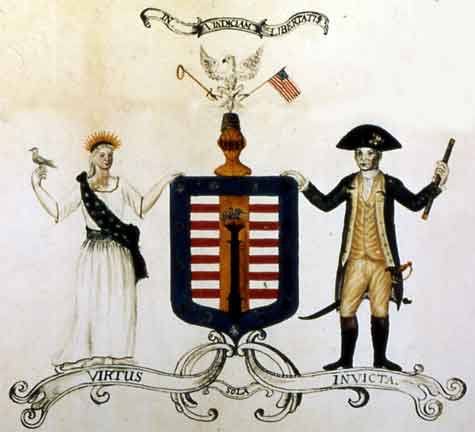
At the top of the seal is a white eagle holding the American flag and a sword with a wreath of laurel. The shield is supported on its left side by an American warrior and on its right by the "Genius of the American Confederated Republic" represented by a maiden, with a dove perched on her right hand. Barton said, the dove is "emblematical of Innocence and Virtue."
Upper motto: "In Vindiciam Libertatis" – In Defense of Liberty
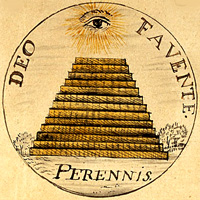
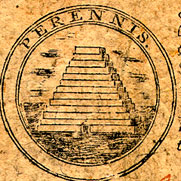
For the reverse side Barton suggested a pyramid of thirteen steps with a radiant eye above it. He said, the "Pyramid signifies Strength & Duration." His sketch (below left) was undoubtedly influenced by the pyramid on the $50 Continental Currency note (below right) designed in 1778 by Francis Hopkinson, the heraldry consultant and artist on the second Great Seal committee (1780).
Upper motto: "Deo Favente" – With God's Favor (lit., God Favoring)
Read Barton's description of his complex design – an excellent example of how the science of heraldry precisely describes an image.
His remarks offer a fascinating glimpse into the mind of revolutionary America.
Once again, Congress was not impressed and a month later turned over Barton's design – along with the other two committees' designs – to Charles Thomson, whom they counted on to come up with a Great Seal worthy of their victorious new nation.
|
Historical content is based on the official history of the Great Seal.
Online since 1998 • Webwright: John D. MacArthur
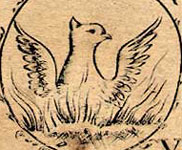 On the pillar in the shield is a "Phoenix in Flames." Baron said, "The Phoenix is emblematical of the expiring Liberty of Britain, revived by her Descendants, in America." Earlier there had been a mythical phoenix on South Carolina's five-shillings note (left) issued in 1778. (Barton used another bird, a rooster, at the top of his first design, which was even more complex than this one.)