|
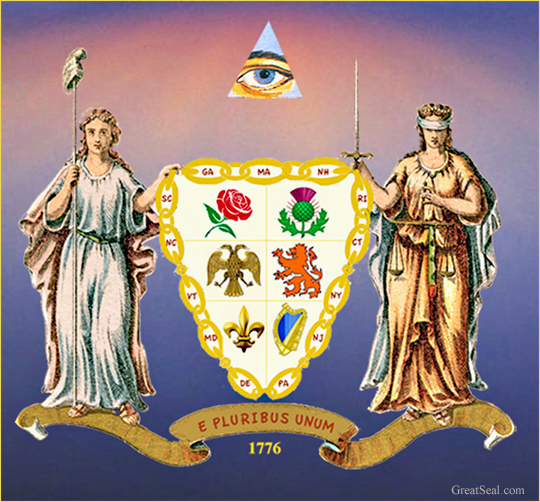
First Great Seal Committee – July 1776
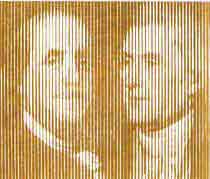 "Resolved, That Dr. Franklin, Mr. J. Adams and Mr. Jefferson, be a committee, to bring in a device for a seal for the United States of America." – July 4, 1776, Journals of Continental Congress
For the design team, Congress chose the authors of the Declaration of Independence. Although these distinguished Founders were among the ablest minds in the new nation, they had little knowledge of heraldry. To help convey their vision, they asked Pierre Eugène Du Simitière to work with them.
Skilled in portraiture and heraldry (the Delaware and New Jersey state seals are his designs), Du Simitière was also an avid collector of all things American and founded the first history museum in the United States.
The fascinating story of the committee's suggestions is
available online (free and in several file formats):
https://archive.org/details/TheEagleAndTheShield
Here is the official description of the design they
recommended to Congress on August 20, 1776:
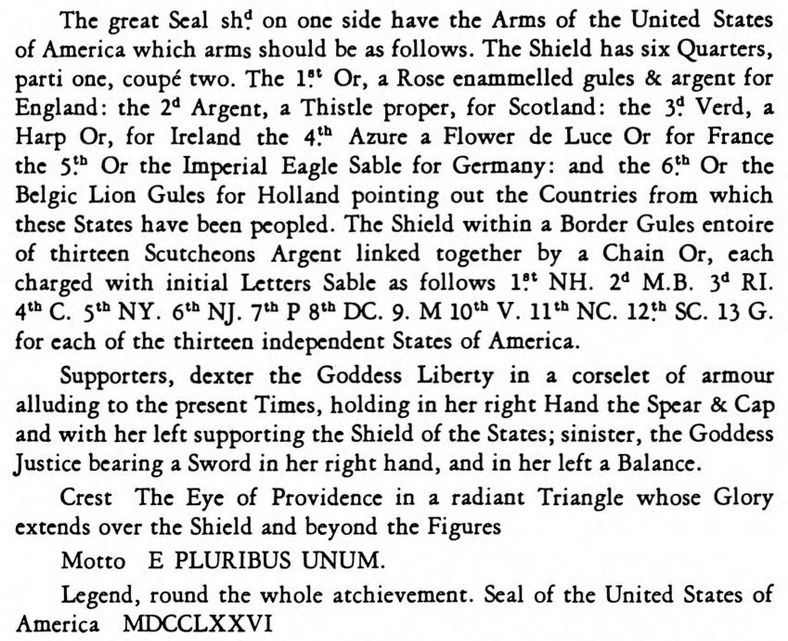
Page 26 of The Eagle and the Shield
No illustration (realization) was made of their design, however Du Simitière did make a rough sketch of his preliminary design that had one difference: a soldier instead of the Goddess Justice:
"Senester, an American Soldier, compleatly accoutred in his hunting Shirt and trowsers, with his tomahawk, powder horn, pouch &c. holding with his left hand his rifle gun rested."
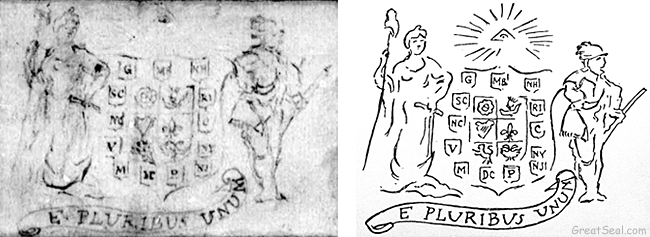
Du Simitière's original sketch and a restored version
2020: It's time to take a fresh look at this symbol of America that our most esteemed Founders recommended. Their call for liberty, justice, and unity resonates more than ever today.
This is only a start. See details.
The Shield has the "Countries from which these States have been peopled":
- Rose for England
- Thistle for Scotland
- Imperial Eagle for Germany
- Belgic Lion for Holland
- Fleur-de-lis for France
- Harp for Ireland
Around the Shield is a Border of thirteen shields linked together by a golden Chain –
with initial Letters for "each of the thirteen independent States of America."
Supporting the Shield:
• "The Goddess Liberty in a corselet of armour alluding to the present Times, holding in her right Hand the Spear & Cap and with her left supporting the Shield of the States." She is on the right (dexter) side of the shield.
• "The Goddess Justice bearing a Sword in her right hand, and in her left a Balance." She is on the left (sinister) side of the shield.
Crest: "The Eye of Providence in a radiant Triangle whose Glory extends over the Shield and beyond the Figures."
Date: MDCCLXXVI (1776)
Motto: E PLURIBUS UNUM
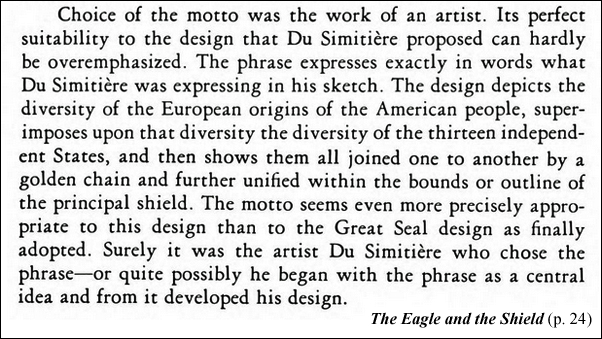
Only the committee's written description was submitted to Congress on August 20, 1776. That same day, it was "Ordered, To lie on the table." There would be two more committees before a Great Seal was approved.
Several of the first committee's suggestions, however, are used in the final Great Seal (1782): the motto E Pluribus Unum; the glory (rays of light); the eye of Providence in a triangle; the date MDCCLXXVI (1776).
Below is the only known drawing (called a "realization") of the first committee's 1776 design for the symbol of the United States. It was done in 1856 by Benson J. Lossing. (Note: Du Simitière said the initials of the 13 states surround the shield, not the entire seal as Lossing showed.)
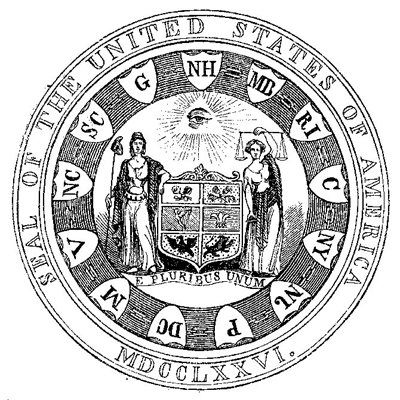
Lossing also drew a realization of the committee's
design for the reverse side of the Great Seal.
| 