Original Source of ANNUIT COEPTIS
Motto Above the Eye of Providence on the Great Seal
The motto Annuit Coeptis was suggested by Charles Thomson in June 1782. He adapted it from Virgil, the renowned Roman writer's evocative instruction manual for farmers, The Georgics, written in the first century B.C.:
"Da facilem cursum, atque audacibus annue cœptis."
This sentence (Book I, line 40) has been translated as:
"Give me an easy course, and favor my daring undertakings."
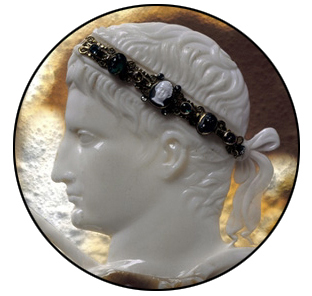
It is part of Virgil's appeal to the godlike Augustus Caesar for success in his poetic efforts to effectively convey crucial information to farmers. Below are two English translations of the Latin: by Smith Palmer Bovie (1956) and by John Dryden (1697).
|
Whatever form, O Caesar, you assume,
Smooth my path, condone this enterprise
Of bold experiment in verse, and share
Concern with me for uninstructed farmers:
Grow used to prayers appealing to your name.
|
|
Be thou propitious, Caesar! guide my course,
And to my bold endeavors add thy force:
Pity the poet's and the ploughman's cares;
Interest they greatness in our mean affairs,
And use thyself betimes to hear and grant our prayers.
|
"Audacibus annue coeptis" is also found in Book IX of Virgil's Aeneid, his epic masterpiece about the foundation of Rome. English translations include: "Assent to my bold attempt" and "Grant me success in this brave venture." and "Nod assent to the daring work I have in hand."
Charles Thomson, an expert in Latin, changed the second-person "annue" to its third-person form "annuit" and coined the motto: "Annuit Coeptis" – placing it above the eye of Providence where he explained it signified the "many signal interpositions of providence in favor of the American cause."
An accurate translation of Annuit Coeptis is:
"Providence Has Favored Our Undertakings."
Note: "Coeptis" is interchangeable with "cœptis." That "œ" is an example of a ligature where two letters are combined into a single character.
The year after choosing this motto, Thomson wrote to his wife Hannah: "I entertain a fond hope that the same kind providence which has conducted us so far in our journey will open a way for the future happiness and prosperity of the United States."
Virgil's Eclogue IV inspired the motto beneath the pyramid: novus ordo seclorum. And his Aeneid mentions the ancient symbol of peace, the olive branch now held by the American bald eagle.
Top image: Cameo of Augustus Caesar, the first Roman emperor,
who was considered a semi-divine being and named a god after his death.
